
PERILOUS TIMES FOR COLLEGE EDUCATED
BLACK WOMEN
K E N A N I N S T I T U T E R E P O R T | J A N U A R Y 2 0 2 6
Melody Riley Johnson, DHSc, MBA
James H. Johnson, Jr., PhD
Urban Investment Strategies Center
UNC Kenan-Flagler Business School
University of North Carolina at Chapel Hill
uisc.kenaninstitute.unc.edu



Home | Publications | PERILOUS TIMES FOR COLLEGE EDUCATED BLACK WOMEN
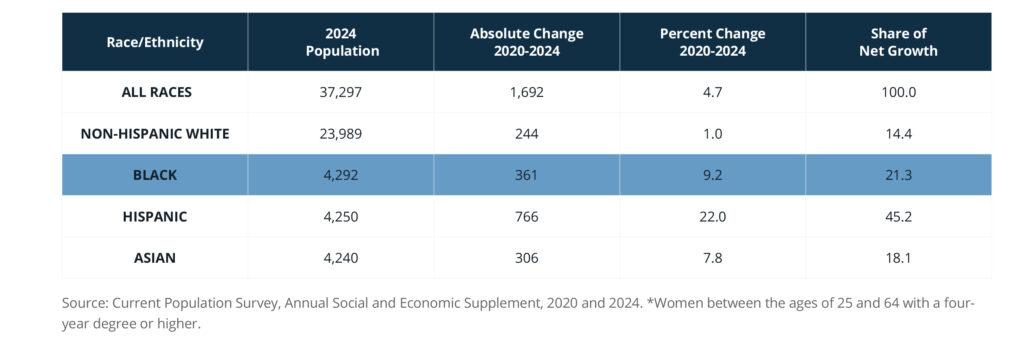
One of the fastest-growing group of college educated women in the United States is also among the most economically vulnerable. Black women were responsible for one fifth of the nation’s college educated female population growth between 2020 and 2024. Among women between the ages of 25 and 64 with a four-year degree or higher, Black women ranked second behind Hispanic women, who accounted for almost half the net growth (45%), and above Asian and non-Hispanic White women, who were responsible for 18% and 14% of absolute growth, respectively. And while the population of all college educated women increased by 4.7 percent, the college educated Black female population increased by 9.2 percent between 2020 and 2024 (Table 1).
The Paradox
However, in contrast to college educated women of other races, and despite rapid growth and reportedly some of the highest labor force participation rates in the country (Cooper & Opoku-Agyeman, 2025), Black women have experienced the brunt of recent job loss in the U.S. economy (Velshi, 2025). Between August and September of 2025, according to Bureau of Labor Statistics, the unemployment rate for Black women increased more rapidly (from 6.7% to 7.5%) than the unemployment rate for White women (from 3.2% to 3.4%) (Joint Center, 2025). In absolute numbers, more than 300,000 Black women exited the labor market during this period (Asare, 2025). Two explanations have been advanced for the sharp uptick in Black female unemployment. The first is that the disproportionate concentration of less than college educated Black women in “volatile sectors like retail and hospitality makes them ‘canaries in the coal mine’ in the current economic downturn” (Cooper and Opoku Agyeman, 2025). The second is that the downsizing of federal government departments and agencies as well as the dismantling of DEI programs and equity focused initiatives in both public institutions and private sector organizations have disproportionately impacted college educated and professional Black women (Haider & Mason, 2025). While plausible, the veracity of these arguments must await future releases of data from the Census Bureau and the Bureau of Labor Statistics. Meanwhile, a substantial body of prior research offers insights into a set of longstanding challenges that will require major workforce and workplace as well as healthcare delivery accommodations to ensure college educated and professional Black women can successfully compete in the U.S. labor market moving forward (Sasson & Haywood, 2019; McCoy, 2023; Colen, Pinchak & Barnett, 2020; Omowale, Mangum, & Slatton, 2024; Okoji, 2022; Riley Johnson, 2024).
Role Management & Health Challenges
Studies confirm that balancing multiple societal roles (e.g., as sole or primary household breadwinner, motherhood, and/or caretaker for aging family members) while simultaneously navigating competitive workplace dynamics exact an especially heavy toll on the health and wellbeing of Black women (Riley Johnson, 2024). Often, the agency necessary to meet and exceed performance expectations is not fully available to professional Black women in work environments (COQUAL, 2019; Riley Johnson, 2024). And the negative health outcomes of these barriers and constraints are alarming.
Among the U.S. female population, Black women experience health issues earlier in life than women of other race/ethnic backgrounds and on average are 7.5 years older biologically than White women 49-55 years of age; carry the highest mortality for all cancers combined; bear the greatest burden of hypertension, stroke, heart failure, and coronary artery disease; and four out of five are obese or overweight (CDC,2022; Chinn et al, 2021; Kanchi et al, 2018; Ebong & Breathett, 2020). Further, and most disconcerting, research confirms these inequities hold true irrespective of Black women’s socio-economic status, meaning advanced levels of educational attainment, well-paying jobs with benefits, and residing in “safe” neighborhoods or zip codes do not protect the health of Black women (Garovic and Kattah, 2022; Assari, Lapeyrous, & Neighbors, 2018).
Simply put, Black and Whites do not share the same health benefits of advanced education and increased incomes. In fact, research on the self-reported health status of various demographic groups has demonstrated statistically that Blacks experience “diminished returns” from advanced education, which exacerbates health gaps for a population that is already significantly predisposed to health risks (Assari & Zare, 2024).
Emblematic of this reality, the Pregnancy Related Mortality Ratio (PMPR) is 5.2 times higher for college educated Black women than their college-educated White counterparts (Petersen, et al, 2019; also see, Hill, Rao, Artiga, & Ranji, 2025; St. Catherine University, 2021). As declared by the CDC and confirmed by other research, these inequities are not solely due to behavioral or biological differences but stem from systemic issues, including historical devaluation of Black bodies and implicit racial bias in health care (see, for example, Wamsley, 2021; Macias-Konstantopoulos, et al, 2023).
Workplace Challenges
Making matters worse, bias does not just reside in healthcare. It also is endemic to many workplace cultures, as revealed in a recent exploratory study of what it is like to be Black in corporate America and other work environments (COQUAL, 2019). Among the study’s key findings:
- Black women (16%) were more likely than White women (2%) to feel someone of their race would never achieve a top position at their company.
- Black women (69%) were more likely than White women (16%) to feel Black employees must work harder to advance.
- Black women (35%) were more likely than White women (20%) to believe people at their workplaces are afraid to address bias when it occurs.
- Black women (30%) were less likely than White women (40%) to have access to senior leaders at work.
- Black women (35%) were less likely than White women (41%) to report managers that give them growth opportunities.
When combined with the often-repetitive cycle of proving value by taking on high risk, high stress assignments, these attitudes, or realities for some, create unparalleled obstacles to success and advancement (Saunders & Hyter, 2019).
Research confirms that these conditions often diminish Black women’s ambitions for upward mobility in organizations (Lui, 2025). And in many cases the absence of appropriate HR accommodations undergird professional Black women’s exits from their organizations or careers- -and in some instances, from the workforce altogether (Riley Johnson, 2024).
Sometimes the exits are voluntary. In the COQUAL (2019) study, for example, Black women (36%) were more likely than White women (27%) to express intentions to leave their current company within two years. In other instances, the exits are involuntary; that is, professional Black women are forced to leave for alleged poor performance when in reality their ability to perform at a high level is severely limited or constrained by a host of personal and/ or household challenges and work-related health issues that may not be evident or visible in routine workplace interactions (Johnson, Appold, & Bonds, 2025b).
Entering 2026, numerous organizations are adopting practices championed by the Department of Government Efficiency (DOGE), such as doing more with less, enforcing return-to-work policies, focusing on profit and loss as well as employee performance metrics, and revising compensation policies (Stewart et al., 2025). This, along with the elimination of DEI practices, is a strong signal that there will be fewer workforce accommodations leaving workers to make the choice to comply or leave. According to Needleman and Hornstein (2025), the message is “Bend the knee or go work somewhere else… get on board or quit.” Ultimately, this scenario will lead to increased workplace anxiety, burnout, and possibly depression.
Stewart et al. (2025) reported speaking with ten workers in the Tech space who shared that colleagues have begun taking mental health leaves to get rest.
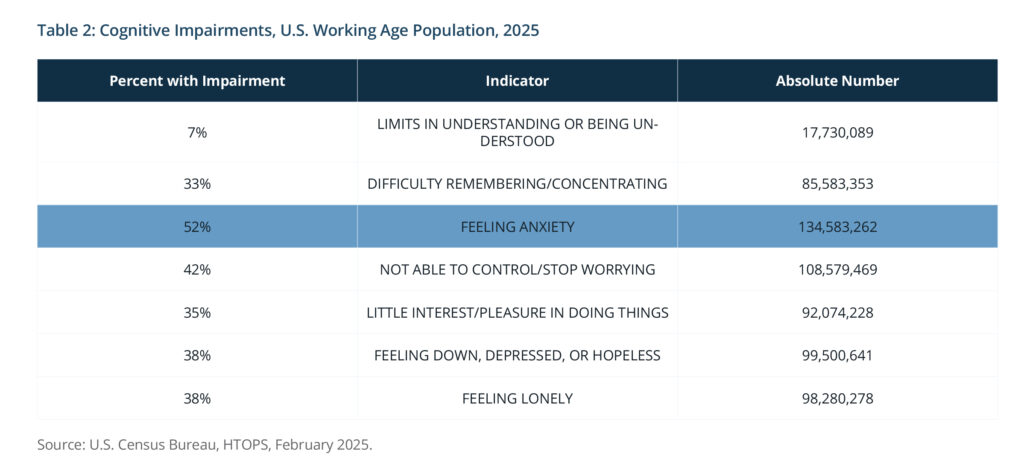
Recent data indicates that among cognitive impairments observed in the working-age population, anxiety is the most prevalent, affecting 52% of individuals (Table 2). This confirms that unyielding environments will bring added pressure to an already cognitively impaired, burdened population. “Cognitive impairments are defined as problems with a person’s ability to think, learn, remember, use judgment, and make decisions. Reported impairments range from communication deficits–difficulty understanding or being understood—to reports of feeling down, depressed, or hopeless, among others” (Johnson, Appold, & Bonds, 2025a).
All employees will be vulnerable in such settings. Black women as evidenced by the earlier shared COQUAL data find many professional settings challenging to navigate. The afore-mentioned hardline ultimatums will create more navigational issues given 60.2 percent of Black households are headed by women (Goodman et al., 2021). Due to financial obligations many may be forced to conform or bend the knee, bringing additional stress to the equation.
Recommended Actions
The challenges that college educated Black women face accentuate the urgent need for an all-hands-on deck approach to successfully nurture, grow, and develop the U.S. workforce of the future (Johnson, Appold, & Bonds, 2025a). Three recommendations are offered here.
First, to reduce health inequities among women, the U.S. health care system and its providers must demonstrate a much higher level of sensitivity and unwavering commitment to specifically addressing the unique health care needs of Black women. That includes having culturally competent staff with the active listening skills to “hear” and “respond” to the expressed concerns and needs of Black female patients (Riley Johnson, 2024). Additionally, employers must challenge the myth of meritocracy and hold leaders accountable for creating inclusive environments where trust and respect permeate (COQUAL, 2019); in turn lowering anxiety, reducing stress and stress related conditions such as hypertension. More than 50% of Black women suffer from hypertension (Kalinowski et al, 2021).
Second, and more broadly, given the impact of ongoing turbulence and uncertainty on college educated Black women–and U.S. individuals and households in general, government, K-20 education system, and other public and private sector leaders should mandate that their organizations conduct pulse surveys like the Census Bureau’s monthly Household Trends and Outlook Pulse Survey (HTOPS), which is designed “to efficiently collect data on emerging social and economic matters facing U.S. households” (U.S. Census Bureau, 2025). At the organization or firm level, the pulse survey should be administered quarterly and designed to identify and monitor barriers, constraints, and challenges that affect employee morale and performance.
Such surveys, as we have explained elsewhere (Johnson, Appold, & Bonds, 2025a), are necessary because many of the challenges that college educated Black women, and other employees face or experience fall into a category we define as iceberg demographics. That is, like the 90 percent of a freshwater iceberg that is below the water line, many of the forces that shape or affect employee morale, behavior, and performance may not be visibly apparent or evident in routine encounters. In fact, they may be misconstrued as signs of disinterest, disengagement, or incompetence (Johnson, Appold, & Bonds, 2025a).
Iceberg demographic workforce and workplace barriers can exist at the person-level (e.g., cognitive impairments and autoimmune diseases like rheumatoid arthritis and lupus) or the household level (e.g., food insecurity and/ or threats of eviction or foreclosure) (Johnson, Appold, & Bonds, 2025a, b, c). In the current era of ongoing turbulence and uncertainty, pulse surveys will enable organizations to not only assess the frequency of such barriers and constraints. They also will afford organizations the opportunity to demonstrate empathy and compassion by developing and implementing accommodation policies, programs, practices, and procedures that are responsive to employee needs (Johnson, Appold, & Bonds, 2025c). Employers are advised to think twice before using a “get on board or quit” approach to boost efficiency and growth. Such tactics may lead to negative feelings within the organization and in the marketplace, which could ultimately harm future workforce development when the market shifts back in favor of employees (Stewart et al., 2025).
Properly executed, pulse surveys can lead to data-driven human resource management strategies and policies that reduce costly employee turnover (i.e., quits and terminations) by improving employee morale, health, well-being, and sense of belonging in workplaces (Johnson, Appold, & Bonds, 2025a,b,c,d). By introducing these data-driven strategies, organizations can establish supportive frameworks that encourage greater engagement among Black female employees and the wider workforce.
Finally, higher education institutions must do a better job of equipping Black females—indeed all graduates—with the requisite business and professional communication skills that employers are demanding in today’s turbulent and uncertain global business environment. To paraphrase Mahin & Johnson (2025), communication is not fluff, it is performance infrastructure, a core operating asset required for organizations to “groove on the ambiguity” that characterizes business and society today. Particularly for Black women, deploying best in class communication and self-advocacy skills will likely reduce stress induced health conditions often associated with the pressures of navigating workplace dynamics and role conflicts; and, by extension, enhance their ability to perform at high levels in today’s ever-changing business environments.
References Cited
Asare, Janice Gassam, 2025, “No Friends in the Pipeline: Why 300,000 Black Women Were Pushed Out of the Workforce,” Forbes, August 6, available at https://www.forbes.com/sites/janicegassam/2025/08/04/no-friends-in-the-pipeline-why-300000-black-women-were-pushed-out-of-the-workforce/.
Assari, S., Lapeyrouse, L., & Neighbors, H., 2018, “Income and self-rated mental health: Diminished returns for high income Black Americans,” Behavioral Sciences, 8(5), 50. MDPI AG, available at http://dx.doi.org/10.3390/bs8050050.
Assari, S., & Zare, H., 2024, “Educated but Unhealthy? Examining Minorities’ Diminished Returns,” Global journal of epidemiology and infectious disease, 4(1), 82–91, available at https://doi.org/10.31586/gjeid.2024.1105. CDC, 2022, Overweight and obesity, Centers for Disease Control, available at https://www.cdc.gov/obesity/strategies/index.html.
Chinn, J. J., Martin, I. K., & Redmond, N., 2021, “Health equity among Black women in the United States,” Journal of Women’s Health, 30(2), 212–219. https://doi.org/10.1089/jwh.2020.8868.
Colen, Cynthia G., Pinchak, NIcolo P., & Barnett, Kierra S., 2020, “Racial Disparities in Health Among College-Educated African Americans: Can Attendance at Historically Black Colleges or Universities Reduce the Risk of Metabolic Syndrome in Midlife?,” American Journal of Epidemiology, November 5, available at https://academic.oup.com/aje/article/190/4/553/5956265.
Cooper, Marianne & Opoku-Agyeman, Anna Gifty, 2025, “Rising Unemployment Among Black Women Is a Bad Sign for the Economy,” Time, September 9, available at https://time.com/7315624/rising-unemployment-black-women-economy/.
COQUAL, 2019, Being Black in Corporate America, An Intersectional Exploration, December 14, available at https://coqual.org/reports/being-black-in-corporate-america-an-intersectional-exploration/.
Ebong, I., & Breathett, K., 2020, “The cardiovascular disease epidemic in African American women: Recognizing and tackling a persistent problem,” Journal of Women’s Health (2002), 29(7), 891–893, available at https://doi.org/10.1089/jwh.2019.8125.
Garovic, Vesna & Kattah, Andrea, 2022, “Money is Not Enough: Diminishing Returns in Black Women Hospitalized for Preeclampsia,” JACC Adv., August 26, available at https://pmc.ncbi.nlm.nih.gov/articles/PMC11198559/.
Goodman, L., Hyun Choi, J., & Zhu, J,. 2021, More Women Have Become Homeowners and Heads of Household. Could the Pandemic Undo That Progress?, March 16, Urban Institute, available at https://www.urban.org/urban-wire/more-women-have-become-homeowners-and-heads-household-could-pandemic-undo-progress.
Haider, Areeba and Mason, Jessica, 2025, “The Economy Sheds 35,000 Jobs for Women as Black Women’s Unemployment Remains High/Jobs Day December 2025,” National Partnership for Women and Families, December 16, available at https://nationalpartnership.org/economy-sheds-35000- jobs-for-women-jobsday-dec-2025/.
Hill, Latoya, Rao, Alisha, Artiga, Samantha, & Ranji, Usha, 2025, “Racial Disparities in Maternal and Infant Health: Current Status and Key Issues,” Kaiser Family Foundation (KFF), December 3, available at https://www.kff.org/racial-equity-and-health-policy/racial-disparities-in-maternal-and-infant-health-current-status-and-key-issues/#:~:text=Research%20shows%20that%20this%20disparity,leading%20causes%20for%20infant%20 mortality.
Johnson, Jr., James H., Appold, Stephen J., & Bonds, Jeanne Milliken , 2025a, “Embrace Iceberg Demographics as a Talent Management Strategy,” HR Exchange Network, August 22, available at https://www.hrexchangenetwork.com/hr-talent-management/articles/embrace-iceberg-demographics-as-a-talent-management-strategy.
Johnson, Jr., James H., Appold, Stephen J., & Bonds, Jeanne Milliken, 2025b, “Recruit and Retain Women At Work,” HR Exchange Network, September 8, available at https://www.hrexchangenetwork.com/dei/articles/recruit-and-retain-women-at-work
Johnson, Jr., James H., Appold, Stephen J., & Bonds, Jeanne Milliken, 2025c, “Recommit to the American Ideal by Embracing Iceberg Demographics,” HR Exchange Network, October 3, available at https://www.hrexchangenetwork.com/dei/articles/recommit-to-the-american-ideal-by-embracing-iceberg-demographics.
Johnson, Jr. James H., Appold, Stephen J., & Bonds, Jeanne Milliken, 2025d, “Support Single Fathers in thew Workforce and Workplaces,” HR Exchange Network, October 21, available at https://www.hrexchangenetwork.com/dei/articles/support-single-fathers-in-the-workforce-and-workplaces
Joint Center, 2025, “Jobs Day Analysis September 2025,” Joint Center for Political and Economic Studies, November 20, available at https://jointcenter. org/september-2025-jobs-day-analysis/7
Kalinowski, J., et al, 2021, ‘Stress Interventions and Hypertension in Black Women,” Women’s Health, 17, available at https://doi. org/10.1177/17455065211009751.
Kanchi, R., et al, 2018, “Gender and Race Disparities in Cardiovascular Disease Risk Factors among New York City Adults: New York City Health and Nutrition Examination Survey (NYC HANES) 2013–2014.” Journal of Urban Health, 95(6), 801–812. https://doi.org/10.1007/s11524-018-0287-x
Lui, Jennifer, 2025, “There’s a Growing Ambition Gap Between Men and Women at Work, Says New Report—Here’s Why,” cnbc.com, December 9, available at https://www.cnbc.com/2025/12/09/lean-in-x-mckinsey-report-growing-ambition-gap-between-men-and-women-at-work.html.
Macias-Konstantopoulos, Wendy L., et al., 2023, “Race, Health Care, and Health Disparities: A Critical Review and Recommendations for Advancing Health Equity,” West J Emerg Med, August 8, available at https://pmc.ncbi.nlm.nih.gov/articles/PMC10527840/.
Mahin, Stephanie & Johnson, Jr., James H., 2025, “A Strategic Imperative: Elevate Communication in Higher Education, Public Ed Works, November 13, available at https://blog.publicedworks.org/2025/11/a-strategic-imperative-elevate-communication-in-higher-education/.
McCoy, Jillian, 2023, “Racism, Sexism, and the Crisis of Black Women’s Health,” The Brink, October 31, available at https://www.bu.edu/articles/2023/ racism-sexism-and-the-crisis-of-black-womens-health/#:~:text=Black%20women%20are%20more%20likely,or%20have%20uncontrolled%20 blood%20pressure.
Needleman, S. E., & Hornstein, J., 2025, From Palantir to AT&T, CEOs Are Demanding Employee Loyalty On DEI, AI, and Remote Work, Business Insider, November 13, available at https://www.businessinsider.com/ceos-dei-ai-remote-work-culture-agree-quit-2025-11.
Okoji, Uchenna, 2022, “The Impact of Structural Racism on Black Women’s Health,” Drexel University College of Medicine, July 7, available at https:// drexel.edu/medicine/academics/md-program/scholars-programs/womens-health-education-program/whep-blog/impact-of-structural-racism-on-black-womens-health/.
Omowale, Serwaa S., Mangum, Laurenia C. & Slatton, Brittany C., 2024, “Work as a Social Determinant of Maternal Health: A Qualitative Exploration of College-Educated Black Women’s Experiences at Work During Pregnancy and Postpartum,” Women’s Health, December 4, available at https:// journals.sagepub.com/doi/full/10.1177/17455057241304842.
Petersen, E. E., et al, 2019, “Racial/Ethnic Disparities in Pregnancy-Related Deaths — United States, 2007–2016,” MMWR Morbidity and Mortality Weekly Report, 68(35), 762–765, available at https://doi.org/10.15585/mmwr.mm6835a3.
Riley Johnson, Melody, 2024, Role Management and Health Status in Generation X Professional Black Women: Exploring the Impact of Socio- Structural Factors Through Lived Experiences, Thomas Jefferson University, Department of Population Health doctoral dissertation, available at https://www.proquest.com/dissertations-theses/role-management-health-status-generation-x/docview/3237210041/se-2.
Sasson, Isaac and Hayward, Mark D., 2019, “Association Between Educational Attainment and Causes of Death Among White and Black US Adults, 2010-2017,” JAMA, August 27, available at https://pmc.ncbi.nlm.nih.gov/articles/PMC6714034/#:~:text=However%2C%20the%20 high%2Deducation%20group,among%20all%20race%2Dsex%20groups
Saunders, J., & Hyter, M. C., 2019, The Black P&L Leader, Korn Ferry Report, available at https://www.elcinfo.com/wp-content/uploads/2019/11/korn-ferry_theblack-pl-leader.pdf
St. Catherine University, 2021, “Understanding Maternal Mortality Rates Among Black Women,” June 13, available at https://www.stkate.edu/ academics/healthcare-degrees/black-women-maternal-mortality
Stewart, A., Langley, H., Russell, M., Whateley, D., Stone, M., Bergman, B., & Torrence, R., 2025, “Tech Employees Are Getting The Message: Playtime’s Over,” Business Insider, March 19, available at https://www.businessinsider.com/tech-industry-amazon-microsoft-meta-google-companies-intensity-hardcore-2025-3.
U.S. Census Bureau, 2025, Household Trends and Outlook Pulse Survey (HTOPS), March 4, available at https://www.census.gov/programs-surveys/ htops.html.
Velshi, Ali, 2025, “300,000+ Black Women Lose Jobs Since Trump’s Return: ‘Impact will Ripple Throughout the Economy’,” available at https:// gwenmoore.house.gov/news/documentsingle.aspx?DocumentID=5739.
Walmsley, Laurel, 2021, “CDC Director Declares Racism A ‘Serious Public Health Threat’,” npr.org, April 8, available at https://www.npr. org/2021/04/08/985524494/cdc-director-declares-racism-a-serious-public-health-threat.
Related Articles

Leading, Managing and Communicating in an Era of Certain Uncertainty
We are living in an era of increasing volatility, uncertainty, complexity and ambiguity—a VUCA World. “Certain-uncertainty” is the new normal in today’s society and economy.

Scapegoating Immigrants in the Covid-19 Pandemic
Immigrants are once again the targets of draconian policy making. It is during the COVID-19 pandemic this time.
Built 2 Last: A Roadmap for Inclusive and Equitable Development in Durham
A roadmap for inclusive and equitable development will increase shared prosperity in Durham: sustainability scorecard; collective ambition community mobilization strategy; inclusive entrepreneurial/ business ecosystem; and equitable community economic development innovations fund.